
Time is our most elusive companion—forever in motion, yet never seen directly.
From ancient days, we’ve chased it with sundials, water clocks, and the quietly mesmerizing hourglass. Today, we chase it still, using lasers and cesium atoms to create clocks so precise they barely lose a second in millions of years.

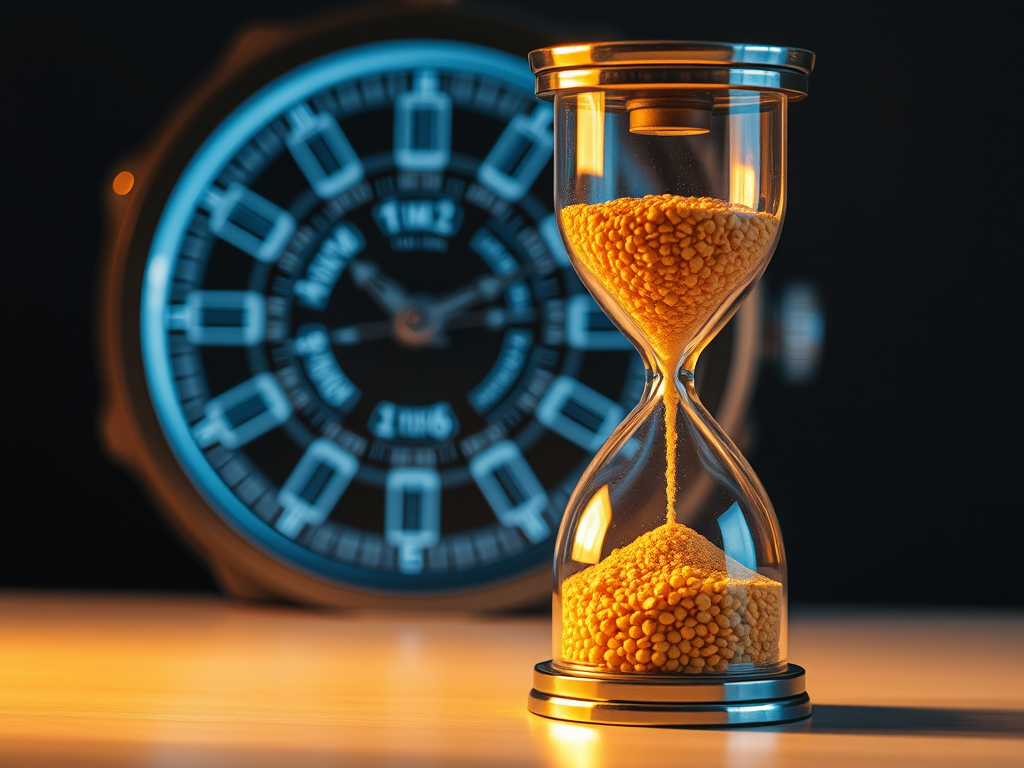
An hourglass is simplicity itself: two bulbs, a slender waist, and fine sand that flows under gravity’s gentle pull. Every grain that falls marks a moment lost—a tiny metaphor for life slipping through our hands. Sailors once used hourglasses to measure watch shifts on turbulent seas, trusting those golden grains more than shifting stars.
Classical physics explains this trickle of sand with laws tying flow rate to gravity, pressure, and sand geometry. Humidity or uneven grains can throw off accuracy, but the hourglass still retains a timeless charm. Perhaps that’s why it endures on desks, in kitchens, and as a profound symbol of passing opportunity.
In contrast, atomic clocks tap into the very fabric of reality: the energy levels of atoms. A cesium atom absorbs and emits electromagnetic waves at a frequency so stable we define one second by its beat. Locked in a vacuum, free from dust and disturbance, these atoms tick away with cosmic consistency.

Atomic clocks lose mere nanoseconds over centuries, guiding GPS satellites and global financial networks alike. This level of exactitude ensures every phone call, stock trade, and rocket launch aligns perfectly in our interconnected world. Without them, our modern tapestry of navigation, data, and science would unravel into chaos.
Hourglasses and atomic clocks couldn’t be more different—one dances with dust, the other sings with atoms. Yet both share a mission: to measure intervals that shape how we live, work, and dream. Each captures a facet of time’s essence: the poetic flow of everyday life and the pristine pulse of quantum law. The hourglass teaches humility: we cannot stop the sand, only witness its fall.
The atomic clock teaches possibility: by harnessing nature’s fundamental rhythms, we can conquer vast distances and unify a global community. Together, they remind us that time is both profoundly human—tied to our mortal span—and deeply cosmic—etched into the universe’s grand design.
We stand at the intersection of sand and subatomic oscillations, bridging ancient wisdom and scientific ambition. Whether we flip an hourglass or calibrate an atomic clock, we honor the same universal truth: each moment is precious and fleeting. And in that fleeting moment, we glimpse both the poetry of existence and the progress of civilization.

So let the sand slip and the atoms dance, for both are invitations to witness time in all its forms. In the end, they show us that measuring time isn’t just about accuracy—it’s about understanding our place in an ever-moving cosmos.
That leaves me personally with a question: how accurately can we measure time? Thats a story for another time.
TS
18.01.2025
Leave a Reply